


The crosier, also called the pastoral staff,
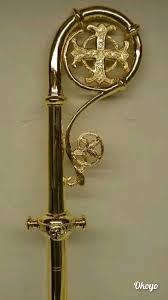
is not an ordinary object in the Church. It is a sacred symbol given to a bishop at his consecration as a sign of his responsibility to shepherd the people of God. In Anglican theology, the crosier represents authority that is exercised in worship, teaching, correction, and pastoral oversight, not personal power or public display (Book of Common Prayer, Ordinal).
The root of the crosier goes back to the image of the shepherd. Jesus Himself is called the Good Shepherd who lays down His life for the sheep (John 10:11). When the Church places the crosier in the hand of a bishop, it is saying clearly that the bishop’s authority must follow the example of Christ—gentle, guiding, correcting, and sacrificial. This authority is functional and liturgical, not ornamental (Bradshaw, 1971).
The Crosier Belongs to Worship, Not Casual Settings
In Anglican tradition, symbols only make sense in the right context. The crosier is meant to be used within a liturgical service, especially during ordinations, confirmations, episcopal visitations, and formal worship where the bishop presides. The Book of Common Prayer makes it clear that episcopal authority is exercised through prayer, Word, and Sacrament, not through everyday movement or informal gatherings (Book of Common Prayer).
When a bishop is visiting people in their homes, attending meetings, or making casual parish visits without worship, the use of the crosier is not appropriate. Outside worship, the bishop still has spiritual authority, but he is not liturgically exercising that authority. That is why the crosier should remain out of sight until worship officially begins.
Marion Hatchett explains that Anglican symbols lose their meaning when they are removed from their proper ritual setting. When sacred objects are used too often or in the wrong context, they stop teaching and start confusing the people (Hatchett, 1981).
Priests and Chaplains Handling the Crosier
One of the worrying practices we see today, especially in some parts of the Church of Nigeria, is priests or chaplains holding the bishop’s crosier in public spaces, on the streets, or during non-liturgical activities. Sometimes, a chaplain is seen standing with the crosier while the bishop is seated in a casual meeting. This is not Anglican practice and has no strong theological backing.
The crosier is not a walking stick, a symbol of escort, or a sign of status. It is tied directly to the bishop’s liturgical action. Paul Avis reminds us that Anglican authority is always exercised within order, humility, and shared responsibility, not dramatic display (Avis, 2007). When the crosier is treated as a public emblem rather than a liturgical sign, it creates confusion about what authority truly means in the Church.
Anglican Practice in the Wider Communion
In most parts of the Anglican Communion, especially in Europe and North America, the use of the crosier is very limited. It usually appears only when the bishop is about to begin worship. The crosier may lead the bishop to the pulpit or cathedra, and once the bishop begins preaching or presiding, chaplains often sit down. This shows that the focus is on the ministry of the Word and Sacrament, not on ceremony for ceremony’s sake (Sykes, Booty & Knight, 1998).
This is why the practice of the Diocese on the Niger under The Right Reverend Ken Okeke is commendable. Allowing chaplains to sit once the bishop is led to the pulpit reflects good Anglican discipline, humility, and theological understanding. Unfortunately, this healthy practice is not always followed in other parts of the Church.
The Danger of Overusing Sacred Symbols
When the crosier is overused or misused, it leads to what we may call symbolic abuse. The symbol becomes louder than the message it is meant to carry. Michael Ramsey warned that the Church must never confuse spiritual authority with external display. True episcopal authority flows from faithfulness to Christ, not from constant visibility of power symbols (Ramsey, 1936).
Anglican tradition teaches restraint. We believe that sacred symbols speak best when they are used sparingly and reverently. When everything becomes ceremonial, nothing remains sacred.
Conclusion
The bishop’s crosier is a holy sign of pastoral authority exercised in worship. It should not be carried during private visits, casual meetings, or non-liturgical activities. Priests and chaplains must also be properly taught when and how it should be handled.
If the Church of Nigeria must remain truly Anglican, we must return to theological discipline, liturgical order, and reverence for sacred symbols. As Scripture reminds us, “Let all things be done decently and in order” (1 Corinthians 14:40).
This is not an attack on culture or personality. It is a call to recover Anglican identity and integrity.
David Nwanekpe