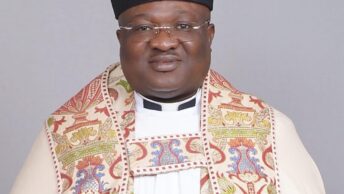



Presenter: Ven. David Nwanekpe
Introduction
Good day, ladies and gentlemen, brothers and sisters in the household of faith, friends on facebook, instagram, X, TikTok, what-app, YouTube and those who visit my website : www.davidnwanekpe.com
Thank you to everyone who followed and supported me throughout my vacation this month. I’m back in New York City, grateful and refreshed. Now let’s get back to our regular social media posts and teaching as we continue the journey together.
Today we will explore a specific but meaningful aspect of Anglican liturgy: the position of the celebrant during the processional movement. Many Anglicans assume that the celebrant must always walk at the back, but the reality is more diverse. This lecture will clarify the origins, meaning, and global variations of this practice within the Anglican Communion.
Understanding the Question
We begin with a simple question:
Is the celebrant always required to process at the back?
The straightforward answer is no. Unlike doctrines or canons, this matter belongs to the realm of ceremonial custom. The Anglican Communion does not impose a universal rule on it, and practices vary significantly depending on tradition, culture, architecture, and churchmanship.
Where the Custom Developed
The idea of the celebrant processing last is most commonly found in High Church and Anglo-Catholic worship settings. This includes many cathedrals, collegiate churches, and parish churches in places such as:
• The Church of England
• The Episcopal Church (TEC)
• Anglo-Catholic dioceses within ACNA
• Cathedrals and diocesan services in Nigeria, Uganda, and Kenya
In these contexts, ceremonial actions follow a structured order with cross, choir, servers, deacon, and finally the celebrant. This reflects a traditional hierarchy of liturgical ministries, inherited from pre-Reformation English ceremonial.
Theological & Liturgical Logic
Why did this custom emerge? Three major reasons can be highlighted:
1. Role of Liturgical Presidency
The celebrant is the president of the Eucharist, responsible for:
• Reconciling the people through absolution
• Presiding at the Great Thanksgiving
• Pronouncing the final blessing
Walking last visually emphasizes that role.
2. Symbol of Order
The structured entrance communicates that worship has intentional order, not chaos. It reflects St. Paul’s instruction that “all things be done decently and in order” (1 Corinthians 14:40).
3. Historical Continuity
English liturgical manuals and cathedral usages from the medieval period preserved hierarchical processional patterns. The Anglican tradition, especially in its more ceremonial expressions, has kept this inheritance as part of its identity.
Where the Custom Is Not Practiced
Many equally faithful Anglican churches do not follow this pattern. Notable examples include:
• Evangelical (Low Church) parishes
• Charismatic Anglican congregations
• Sydney Anglicans in Australia
• Certain ACNA dioceses
• Mission and diaspora churches worldwide
In such places, two alternatives commonly appear:
- Simple entry without a procession, or
- Clergy entering from the vestry, or
- Celebrant entering first or with servers
These adaptations are neither wrong nor un-Anglican. Instead, they reflect different theological emphases and pastoral priorities.
Reasons for Simpler Practice
Why do some Anglicans simplify or omit the custom? Key reasons include:
1. Missional Simplicity
Churches focused on evangelism often remove ceremonial elements to reduce barriers for visitors and new believers.
2. Emphasis on the Priesthood of All Believers
Some communities stress the shared baptismal priesthood (1 Peter 2:9), avoiding elaborate hierarchical symbolism.
3. Practical & Architectural Realities
Mission churches often meet in halls, school auditoriums, or spaces with no aisles or narthex. Processions would be impractical.
Here we see Anglicanism’s pastoral wisdom: ceremonial adapts to mission, not the other way around.
What Do the Prayer Books Require?
It is important to note that:
• The 1662 Book of Common Prayer
• The 1979 Episcopal BCP
• The 2019 ACNA BCP
• The Church of Nigeria’s Prayer Book
do not mandate specific processional orders. Rubrics typically use simple phrases such as “The ministers enter…” without prescribing who goes first or last.
This further confirms that we are dealing with custom, not canon.
The Nigerian Experience
The Church of Nigeria offers a valuable case study. In cathedrals and diocesan events, full ceremonial is often observed, including the celebrant or bishop processing last. At parish level, however, there is significant variation. Some congregations adopt cathedral-style ceremonial, while others favor simpler evangelical approaches influenced by missionary history and African contextual worship.
This diversity shows that Anglicanism can be both catholic and evangelical, both historic and contextual, within one ecclesial tradition.
Conclusion
In summary, the position of the celebrant during the procession teaches us a broader truth about Anglican identity:
• It is not a universal rule.
• It is a custom shaped by history, theology, and mission.
• Both ceremonial richness and simplicity have a place.
• The Communion preserves unity in doctrine while allowing diversity in ceremonial expression.
This flexibility is part of what makes Anglicanism a living and global church capable of celebrating the same Gospel in English cathedrals, African dioceses, American missions, and village congregations around the world.
Thank you.
Selected References
- Bradshaw, Paul. The Search for the Origins of Christian Worship. London: SPCK, 2002.
- Hatchett, Marion J. Commentary on the American Prayer Book. New York: Seabury Press, 1981.