


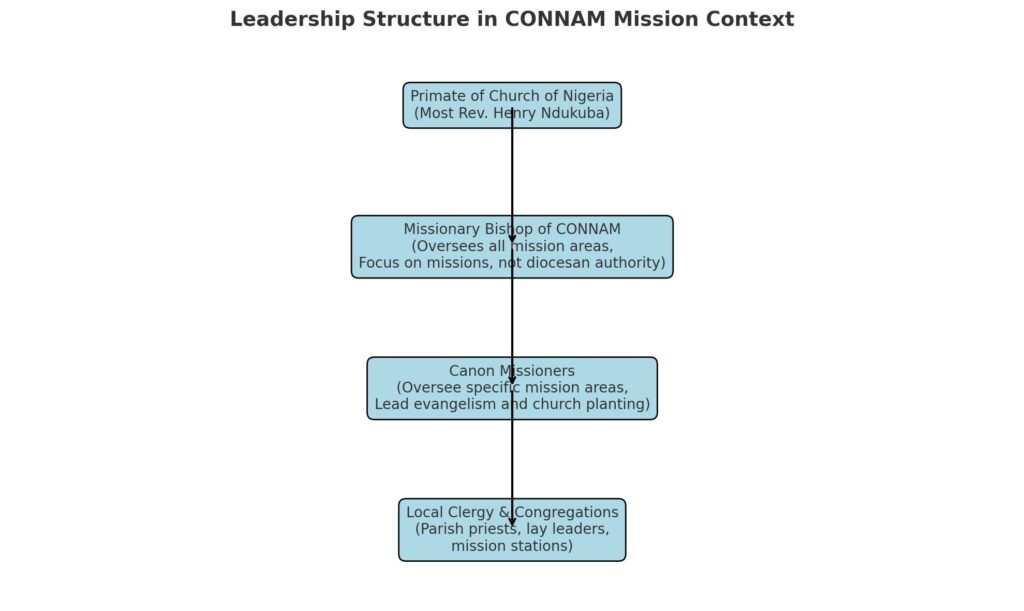
In 2023, the Primate of the Church of Nigeria, the Most Rev. Henry Ndukuba, made a strategic decision to create the office of Canon Missioner within the Church of Nigeria North American Mission (CONNAM). This was alongside the continuing ministry of a Missionary Bishop—an office designed to oversee and coordinate mission work across our vast territory in North America.
Many have asked: What do these titles mean in Anglican tradition, and how do they work in our missionary setting? This article explains both, and why they are important for CONNAM’s growth.
1. The Anglican Meaning of “Canon”
In the Anglican Church, the title Canon is an ecclesiastical dignity normally connected to the life and governance of a cathedral within a diocese. Traditionally:
- A statutory canon is part of the cathedral chapter, with responsibilities in worship, governance, and diocesan mission.
- An honorary canon is a recognition of faithful service, still tied to a diocese, even if the role is largely ceremonial.
In both cases, the word canon implies an attachment to a diocesan structure and its bishop.
2. The Meaning of “Missioner”
The word Missioner is rooted in the Church’s missional calling to go, to plant, to evangelize, to strengthen existing works, and to care for the flock in the field.
In Anglican contexts, a Missioner is typically:
- An evangelist and church planter.
- A support leader for parishes in outreach and discipleship.
- A catalyst for strategic mission expansion, often under a bishop’s mandate.
When combined, Canon Missioner refers to a canon whose particular responsibility is mission. In a diocese, this would mean they are part of the cathedral chapter but focused on evangelistic leadership.
3. What the Primate’s Appointment Means in CONNAM
Here in CONNAM, we are not yet a diocese; we have no cathedral chapter in the statutory Anglican sense. Yet, as a missionary arm of the Church of Nigeria, we have a growing number of congregations across the United States and Canada.
By appointing Canon Missioners, the Primate has:
- Adapted an Anglican office for a missionary context, retaining the honour of the title Canon while deploying it for active field leadership.
- Given certain priests regional oversight for mission areas, similar to how a bishop might appoint area deans or archdeacons in a diocese.
- Strengthened CONNAM’s missionary structure by ensuring each area has a recognized leader for evangelism, church planting, and pastoral care.
While our Canon Missioners do not sit in a cathedral chapter, they are nonetheless appointed leaders in the Church’s mission, with delegated authority from the Primate through the Missionary Bishop of CONNAM.
4. The Role of a Canon Missioner in a Missionary Area
In our context, a Canon Missioner’s duties may include:
- Overseeing Mission Areas — Providing leadership to parishes, mission stations, and clergy in their assigned region.
- Church Planting and Evangelism — Strategically guiding outreach efforts and planting new congregations.
- Clergy Support and Mentoring — Encouraging and equipping priests and lay leaders.
- Mission Planning — Working with CONNAM leadership to identify growth opportunities and develop sustainable strategies.
- Liaising with the Missionary Bishop — Reporting on mission progress, challenges, and needs in their area.
5. The Role of a Missionary Bishop in CONNAM
The Missionary Bishop is a well-established Anglican response to areas where a diocese does not yet exist. Appointed by the Primate, the Missionary Bishop in CONNAM:
- Acts as the chief shepherd and overseer of all churches and mission areas within CONNAM.
- Provides episcopal leadership, including confirmations, ordinations, and pastoral guidance to clergy.
- Coordinates the work of Canon Missioners, ensuring mission efforts are united and strategic.
- Represents CONNAM in the House of Bishops of the Church of Nigeria, giving us a voice at the highest level.
- Lays the groundwork for the future establishment of dioceses in North America.
Important distinction: A Missionary Bishop does not have the same authority as a Diocesan Bishop.
- A Diocesan Bishop presides over a fully established diocese with a cathedral chapter, synod, and statutory governance.
- A Missionary Bishop’s role is focused more on mission development, pastoral oversight, and planting new congregations in areas not yet formed into a diocese.
- His authority is delegated directly by the Primate and is tied to the missionary nature of his assignment, not to the statutory structures of a diocese.
In other words, a Missionary Bishop is a bishop for the mission field—mobilizing, planting, and preparing the ground for the day when a diocese can be born.
6. Historical Anglican Examples of Canon Missioners
The office of Canon Missioner has precedent across the Anglican Communion:
- Church of England — Dioceses like Birmingham and Durham have Canon Missioners dedicated to evangelism and “fresh expressions” of church.
- Anglican Church of Kenya — Canon Missioners lead rural evangelism and coordinate mission stations in developing areas.
- Anglican Church of Southern Africa — The role blends cathedral recognition with itinerant missionary service.
- Church of Nigeria (Before CONNAM) — Canon Missioners have been used in missionary dioceses to oversee regions not yet structured as full archdeaconries.
In every case, the role combines honour with active responsibility, recognizing a leader’s service while equipping them to advance the Church’s missionary mandate.
7. Why These Roles Matter for CONNAM
Both the Missionary Bishop and Canon Missioners show that the Church of Nigeria is thinking strategically and contextually about mission in North America.
- The Missionary Bishop provides episcopal oversight and keeps the mission united under the Primate’s vision.
- The Canon Missioners take mission leadership to the grassroots, ensuring local evangelism and church growth.
Together, they allow CONNAM to operate with Anglican order while adapting to the realities of a mission field that spans a continent.
Conclusion
In Anglican tradition, Canon Missioner is a cathedral office with a mission focus, and Missionary Bishop is an episcopal role for mission areas without dioceses. In CONNAM, these titles have been reimagined for our context—rooted not in diocesan statutes, but in the urgency of the Gospel.
Our prayer is that every Canon Missioner and our Missionary Bishop will serve with the passion of St. Paul, who said:
“Woe to me if I do not preach the Gospel!” (1 Corinthians 9:16)
In the end, titles are tools; what matters most is the fruit of faithful mission and the souls brought into the Kingdom.
Which of those would be most helpful?